Evolution of "ERP"
When companies were small and a single person managed all the different managerial functions, the decisions were made keeping in mind the overall company objectives. But as companies grew, managing the entire operation became impossible for a single person. More and more people were brought in, and different business functions were given to different individuals. When the organisation became larger, each person hired people to assist him/her and the various departments as we see now, evolved. The size of the departments began to increase as more and more people were required to do the job.
As the departments became large, they became closed and watertight. Each department had its own set of procedures and hierarchy. People, at most levels within a department, would just collect and pass information upward. Thus information was shared between departments only at the top level. This led to the fragmentation of information, information being collected at one place and not available for other departments of the organisation to easily access it. This information was not carefully and efficiently handled at the top level of the organisation which led to confusion and loss of information. Many a time’s faulty information was processed to take decisions on some key issues. Some of the developers designed software that provided solution for handling these fragments of information. And IT had started its work in organisations for effective management of all the information of the organisation.
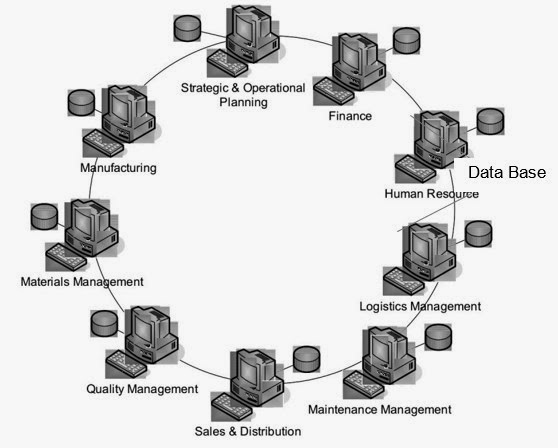
Figure 1.1 shows a pre-ERP scenario.

Figure 1.1: Isolated Information Systems – A Pre-ERP Scenario
Although IT provided the perfect answer, in the haste, most developers ended up developing need-based, isolated, and piecemeal information systems that were non-compatible. In the pre-ERP scenario as depicted in the figure 1.1, the information or data regarding a particular department remained with in the department’s own data base, and no other department could access that information. Only the top level management of the company was able to access this information. Any other department requiring this information had to collect the information from the top management. This led to a fragmented system, each working in isolation without direct communication between each other. The developers concentrated more on making the individual department’s information organisation and maintenance more efficient instead of, integrating all the departments of a company, which was a major draw back. And it is no wonder that IT implementations automated only the existing applications and not the business functions.
Most of this happened because IT was not integrated into the corporate strategy. We have to devise a system with a complete insight of the enterprise so that we can draw real benefits from a technology as powerful as IT. Such a system has to work around the core activities of the organisation, and should facilitate faultless flow of information across departmental barriers. Such systems can optimally plan and manage all the resources of the organisation, and hence, they can be called as Enterprise Resource Planning (ERP) systems.
An Enterprise is a group of people with a common goal, which has certain resources at its disposal to achieve that goal. The group has some key functions to perform in order to achieve its goal. Resources included are money, manpower, materials, and other things that are required to run the enterprise. Planning is done to ensure that nothing goes wrong. Planning means, putting necessary functions in place and more importantly, putting them together. Therefore, Enterprise Resource Planning or ERP is a method of effective planning of all the resources in an organisation.
We have many misconceptions about ERP. The first one is that ERP is a computer system. Yes, computers and IT are integral parts of an ERP system; but ERP is primarily an enterprise-wide system, which encompasses corporate mission, objectives, attitudes, beliefs, values, operating style, and people who make the organisation. The second misconception is that ERP is for manufacturing organisations alone. This assumption is basically due to the way ERP was historically developed from the methods of Material Requirement Planning (MRP) and Manufacturing Resource Planning (MRP-II), which are relevant to manufacturing organisations. In the manufacturing industry, MRP became the fundamental concept of production management and control in the mid 1970s. At this time the prevailing trend in manufacturing industry was Bill of Materials (BOM). BOM is a purchase order management system that utilises parts list management and parts development management techniques. And this concept unfolded from order inventory management of materials to plant. MRP-II was carved out of MRP, consisted Human Resource planning and distribution planning, in turn became MRP-II. This incorporated financial accounting, human resource management functions, distribution management functions, and management accounting functions. It came to globally cover all areas of enterprise core business, and eventually, was called ERP. But in reality, the concept of enterprise-wide planning of resources is not limited to any particular segment of industry.